Woman of Rome_A Life of Elsa Morante by Lily Tuck
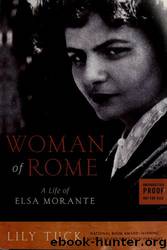
Author:Lily Tuck [Tuck, Lily]
Language: eng
Format: epub
Tags: Biography, history
ISBN: 9780061472565
Amazon: B001CPY1BQ
Goodreads: 2535454
Publisher: Harper
Published: 2008-07-29T00:00:00+00:00
In April 1962, while Bill Morrow was in New York for a brief visit—he was planning to return to Italy and live there permanently with Elsa—he was killed. It was presumed (although never confirmed) that, hallucinating on LSD, he had thought he could fly and he jumped off a Manhattan skyscraper. It has also been said that that day was particularly windy. When Elsa Morante heard the news of Bill’s death, she was devastated. She locked herself up in her bedroom and, for two months, never left it. Prescient perhaps, Moravia had ended his introduction to Bill Morrow’s show at the Galerie Lambert in Paris with the words “And although these paintings appear so immediate, so pure, so calm and limpid, they are born of the rage of a youth spent in the anguish and strangeness of a world profoundly alienated which is that of the United States. Thus, once again, art will have been paid for by life.”9
That year and those that immediately followed must, most certainly, have been among the unhappiest in Elsa Morante’s life. She turned fifty and, added to the remorse and sorrow she felt for the tragic and premature death of Bill Morrow, there might have been another even deeper and crueler reason for her unhappiness. Her marriage to Alberto Moravia, always difficult under the best of circumstances, had come to an end. Moravia left Elsa to live with Dacia Maraini, a younger woman who was a poet, playwright, novelist and journalist. His feelings on leaving Elsa—he and Dacia were on their way to Africa together—Moravia described thus: “During the night, as we were flying out, I was awake and was trying to look down at the shadows of the Sahara. And then all of a sudden I felt a sense of absolute physical liberation. As if I had rid myself of something heavy, like a plaster cast.” Elsa Morante and Alberto Moravia never divorced or got a legal separation. Moravia simply moved out and went to live with Dacia. They remained on cordial terms, seeing each other from time to time, for as Moravia also said, “the separation was never entirely complete.”10 To support Elsa, he opened a bank account in her name—one she could draw on whenever she needed money. Elsa’s needs were modest and she did not often make use of this account; also her books, especially History, brought her income.
After Bill Morrow’s death, Elsa Morante no longer had the desire to write. She abandoned Without the Comfort of Religion, the novel she had been working on. If someone asked what she was doing, she answered that she was “writing very little.” Consumed by grief, idle and restless, Elsa appeared to be living one day at a time. On the spur of the moment, she traveled to Spain, to Greece, to islands in the Mediterranean, sometimes alone or sometimes with a friend or someone she had met by chance. One day, for instance, she called Allen Midgette at his hotel and asked him to go to Spain with her for a few weeks, which he did.
Download
This site does not store any files on its server. We only index and link to content provided by other sites. Please contact the content providers to delete copyright contents if any and email us, we'll remove relevant links or contents immediately.
Cecilia; Or, Memoirs of an Heiress — Volume 2 by Fanny Burney(31957)
Cecilia; Or, Memoirs of an Heiress — Volume 3 by Fanny Burney(31943)
Fanny Burney by Claire Harman(26605)
We're Going to Need More Wine by Gabrielle Union(19050)
Plagued by Fire by Paul Hendrickson(17416)
All the Missing Girls by Megan Miranda(16038)
Cat's cradle by Kurt Vonnegut(15362)
For the Love of Europe by Rick Steves(14149)
Bombshells: Glamour Girls of a Lifetime by Sullivan Steve(14078)
Leonardo da Vinci by Walter Isaacson(13339)
4 3 2 1: A Novel by Paul Auster(12396)
The remains of the day by Kazuo Ishiguro(9002)
Adultolescence by Gabbie Hanna(8929)
Note to Self by Connor Franta(7672)
Diary of a Player by Brad Paisley(7584)
Giovanni's Room by James Baldwin(7350)
What Does This Button Do? by Bruce Dickinson(6208)
Ego Is the Enemy by Ryan Holiday(5453)
Born a Crime by Trevor Noah(5384)
